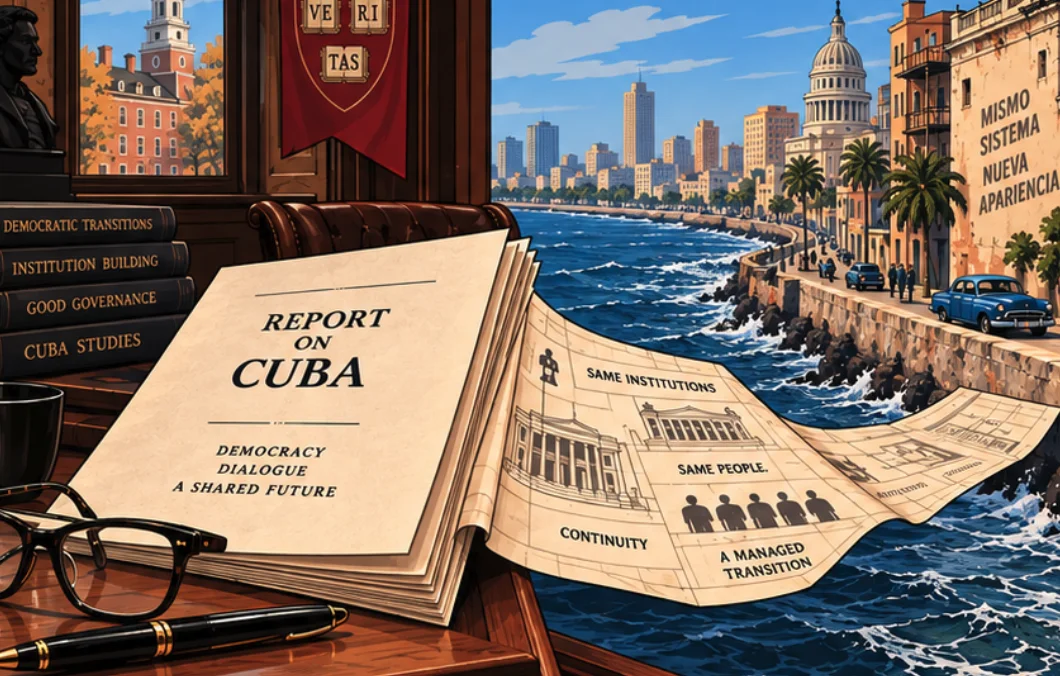
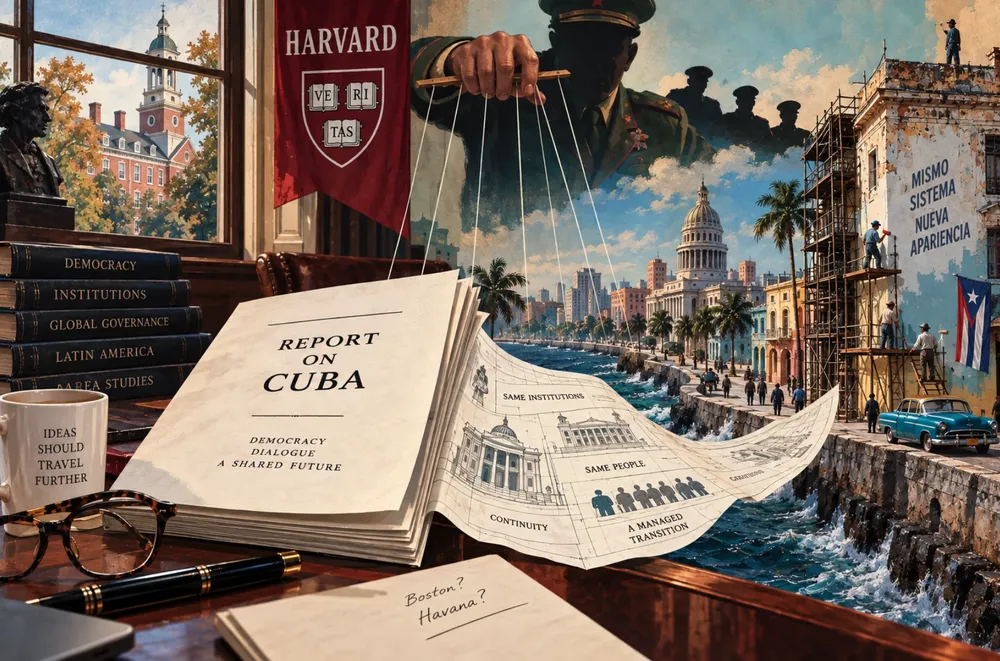
The Harvard Report: Assembled in Boston But Made in Havana

The Harvard Working Group on Cuba’s Future presents itself as a sober academic exercise in mapping a path out of national catastrophe. In reality, it offers something far more insidious: a blueprint for managed continuity under a refurbished dictatorial order. Cloaked in the language of pluralism, gradualism, and pragmatic reform, the document functions less as a roadmap to democracy than as an intellectual warrant for a Cuban variant of post-Soviet concessionary capitalism—the Putinist model in tropical dress. It proposes a transition, yes, but one carefully engineered to preserve the institutional skeleton, personnel networks, and moral impunity of the existing kleptocratic, sultanist regime.
At the core of any genuine democratic transition from totalitarian rule lies transitional justice. Successful passages from communism—or from any system that has systematically violated human dignity—have required retributive measures against those who directed repression, corrective restitution for victims, systemic overhaul that dismantles the security apparatus, and symbolic rupture with the old order. Lustration, vetting of the old guard, historical clarification commissions, and guarantees of non-repetition are not optional flourishes. They are the minimum conditions for preventing the old elite from simply changing uniforms and continuing to rule.
The post-Soviet experience demonstrates the consequences of omitting them. Where accountability was deferred or denied—Russia, Belarus, the Central Asian republics—the result was not democracy but a more flexible, less ideological authoritarianism in which the former party nomenklatura and security services became the new owners of the state and the economy. Georgia, Ukraine, Moldova, and Armenia achieved imperfect democratic openings only after popular upheavals that forced a cleaner break. Nicaragua’s incomplete transition produced the same predictable outcome: the old structures reasserted themselves. The Harvard Report mentions none of this. It is silent on transitional justice, silent on accountability for sixty-seven years of crimes against humanity, silent on the need to dissolve the repressive organs that have sustained the Castroist order. That silence is not an oversight. It is the document’s central political choice.
Instead, the Report leans heavily on the existing constitutional framework. It urges restoration of rights already nominally present in the 2019 Constitution while treating that same instrument as a workable starting point. Yet that Constitution was crafted precisely to constitutionalize the supremacy of the Communist Party and to provide legal cover for the very practices the Report claims to oppose. To treat it as a foundation rather than an obstacle is to accept the regime’s own legal fiction. The proposal for a future Constituent Assembly is deferred to the medium or long term, after the current authorities have already been positioned as “facilitators” of the process. In other words, the architects of the present disaster are invited to design the architecture of the future. This is not democratization; it is co-optation.
The Report’s language of “amnesty” for political prisoners further reveals its orientation. Immediate, unconditional release is a moral and legal imperative. No legitimate state power ever possessed the authority to imprison citizens for the exercise of rights that even the regime’s own documents hypocritically acknowledge. To speak of “amnesty” is to grant implicit recognition to the judicial theater that produced those convictions. It frames freedom as a concession rather than a restoration of what was never legitimately taken.
The same logic appears in the treatment of economic failure. The catastrophe is attributed primarily to inefficiency, poor investment choices, and mismanagement—symptoms, not causes. The deeper etiology—the totalitarian monopoly on power, the systematic destruction of independent social and economic life, and the extraction of wealth by a ruling caste organized around personalist control—is left largely unexamined. The prescription that follows is therefore predictable: improve the performance of the existing system, open space for private property within carefully managed limits, reintegrate into international financial institutions, and invite the diaspora to underwrite reconstruction. The result would be a more productive dictatorship, not a free polity.
Particularly revealing is the Report’s interest in the eventual repeal of the Helms-Burton Act. That statute conditions the lifting of the embargo on concrete political and civil reforms—legalization of political activity, release of prisoners, dissolution of the security apparatus, free elections under international observation, and progress toward an independent judiciary and market economy. Helms-Burton does not permit a soft landing for the old elite. The Harvard document, by contrast, seeks precisely that soft landing. By advocating the removal of the principal legal barrier that ties economic normalization to democratic prerequisites, it supplies an academic rationale for the regime’s long-standing diplomatic objective: relief without surrender of power.
What emerges is a project for enlightened authoritarianism. The Castro-Communist system is to be rationalized, its most egregious inefficiencies corrected, its repressive excesses moderated just enough to unlock external resources, while the hegemonic institutions and the personnel who staffed them remain largely intact. The Soviet precedent is instructive and damning. Failure to confront the past did not produce democracy; it produced a new form of tyranny that proved more durable precisely because it shed the residual ideological constraints of Marxism-Leninism while retaining the instruments of control. The Harvard Report offers Cuba the same bargain. It is a transition from sultanist communism to a more modern, less doctrinaire, but still thoroughly dictatorial order.
True democratic transition demands rupture, not renovation. It requires the dismantling of the structures that made the crimes possible, the exclusion of those who directed them from future positions of power, and the establishment of institutions designed to prevent their return. Anything less is not a pathway to freedom but a sophisticated apology for continuity. The Working Group’s document, for all its academic polish and institutional prestige, is ultimately the intellectual property of the dictatorship it pretends to transcend.

Publicado originalmente en Patria de Martí.


The Uncle’s Request: A Cuban Film at the Manhattan Film Festival

Between Marxists and Cannibals: The Cuban Exiles Who Fought against Socialism in Africa


Personal Memories of a Historic Event “The Peter Pan Program” (Excerpt)*